I build the
whole
machine.
What I love most is taking an empty repo and turning it into something real people download. I've done that once now, alone, every layer of it. The next step is going deeper, down to the hardware itself. This page is honest about what I hold today and what I'm still reaching for.


Where I actually stand.
I designed and built Deltalift alone, from first sketch to store listing. It's live today on Google Play and the App Store.
the proof: Deltalift ↓The backend is mine too: Postgres with row-level security on every table, sync built to survive bad gym wifi, and purchases the server verifies because I don't trust any client, including my own.
how it's built ↓I'll be honest: I haven't trained models myself. At my internship I work with a real ML pipeline every day, wiring sentiment analysis into features people use. My own engines are statistics, and I call them that.
the honest line ↓Where I'm going next. I've repaired machines my whole life; now I want to build one, starting with a BLE sensor that feeds my own app.
read the build log ↓
One person shipped this.
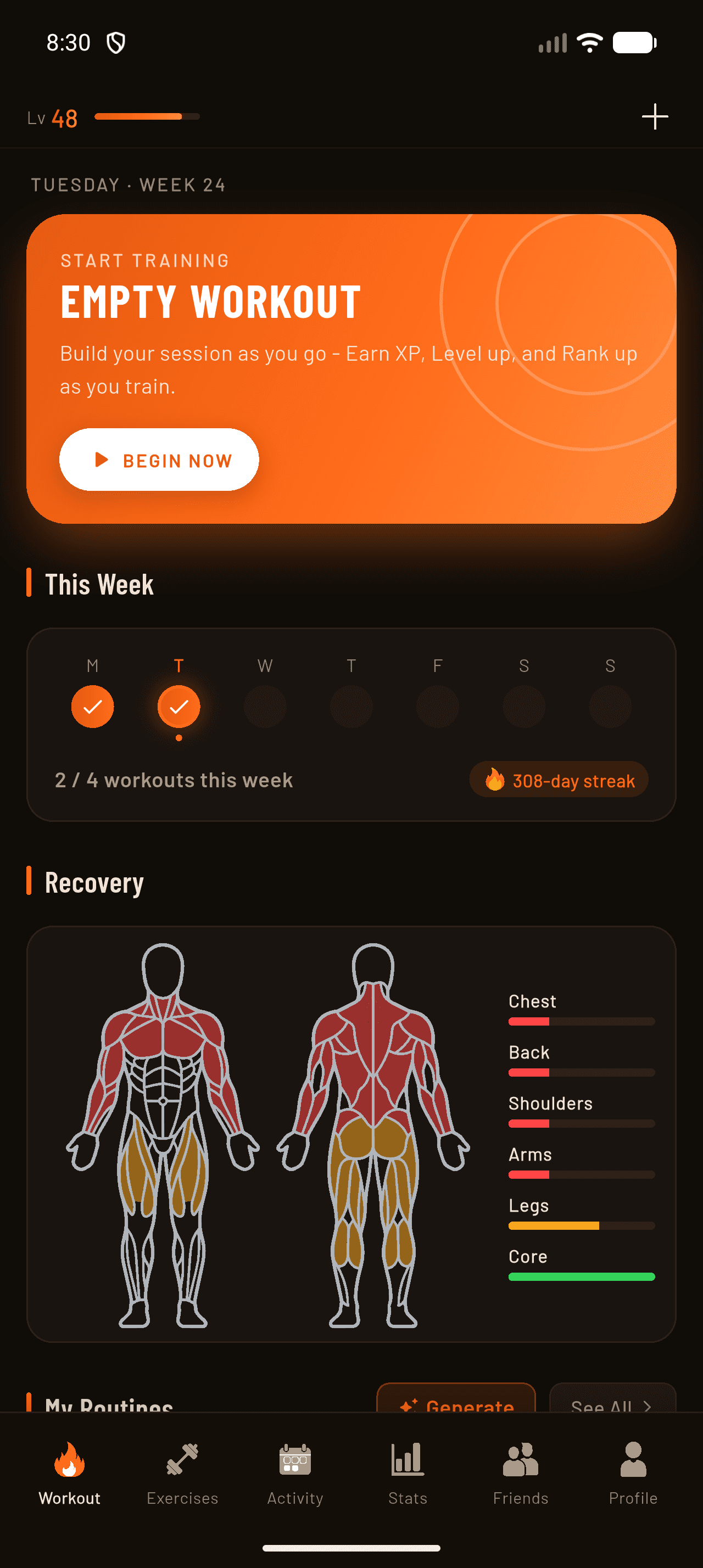
Deltalift is a gamified strength training app for people who want their effort measured honestly. I designed it, built every layer, shipped it to both stores, and I market it too: the site, the store assets, the ad reels. It's the receipt behind the two SHIPPED marks above.


The layer you can hold
A full-body muscle heatmap drawn by a custom SVG painter. A ranking engine calibrated on percentiles across 327 exercises. A 120-day strength forecast from weighted regression. Three languages. All of it works offline, because gyms have concrete walls.
The layer you have to trust
Postgres with row-level security on every table, running on a managed BaaS. No client is trusted, including mine. Offline-first SQLite sync. Store purchases verified server-side through an OAuth2 edge function. A GDPR deletion flow that actually deletes. Push, crash monitoring, the unglamorous rest.
The layer I refuse to oversell
Deltalift's intelligence is statistical: percentile ranks and weighted regression forecasts in pure Dart, decoupled from the UI and unit tested. At my internship I integrate a real ML pipeline, sentiment analysis feeding React Native features I build. That's INTEGRATING, not SHIPPED. The distinction is the point of this page.
The layer that closes the loop
The BLE sensor on my bench exists for one reason: a rep counted by my firmware should travel through my sync layer into my app. When it lands, the whole vertical is mine, device to screen. Status: BUILDING, log below.
Also the parts nobody counts: the marketing site, the store assets, the ad reels. Shipping is the whole job, not the last step.
How deep the roots go.
The silicon layer isn't a costume. Below the apps there's a paper trail of going down the stack for its own sake. Each of these was built to understand the machine, not to pad a CV.
Lexer, parser, AST, type checker, evaluator. No generators, no shortcuts.
Recursive, in C++. Plus an OpenGL renderer with my own GLSL on the real-time side.
SSE-vectorized matrix benchmarks. Cache latency measured level by level, not estimated.
Assembly-level thinking, and operating systems coursework where segfaults teach humility.
Analog and digital coursework with LTspice. An internship at ABB showed me switchgear and battery storage up close.
I built and fixed desktops for clients before I wrote software. Now I keep a gym chain's equipment alive. About 20 000 SEK a year stopped going to service contracts.
The BLE sensor · build log
BUILDING · LIVEWeighing nRF52-class silicon against ESP32. The power budget makes the call, not the hype.
Dev kit on the bench. Blinky, then BLE advertising with a name I'm not announcing yet.
The GATT service: rep events, IMU stream, battery. Deciding exactly what the device owes the app.
On-device rep detection, then the Flutter integration. Deltalift as the first client of my own hardware.
The degree, course by course.
B.Sc. Computer Science. 144 hp completed · 7.5 hp in progress · same marks, same honesty.
I repaired machines before I built them.
I started out building and repairing desktops for people, clients included, long before I wrote real software. Later I kept a gym chain's machines alive, self-taught, hands inside the mechanisms. An internship at ABB gave me a first close look at switchgear and battery storage, and it stuck. Now I'm finishing a B.Sc. in Computer Science in Sweden (2027). Along the way I shipped complete products alone, and led a five-person team when it wasn't alone.
The thread never changed: understand the machine all the way down, then make it useful to a person.
Building a device that needs to think?
I'm looking for the team that wants one person able to own every layer, metal to model to app. Based in Sweden, available now.